Group 2: compare your two ideas
Choose one difficulty to help with. Compare both ideas, make one useful change and explain a fair test. The model examples show design proposals, not equipment proven to work.
Idea 1: Mushroom nightlight
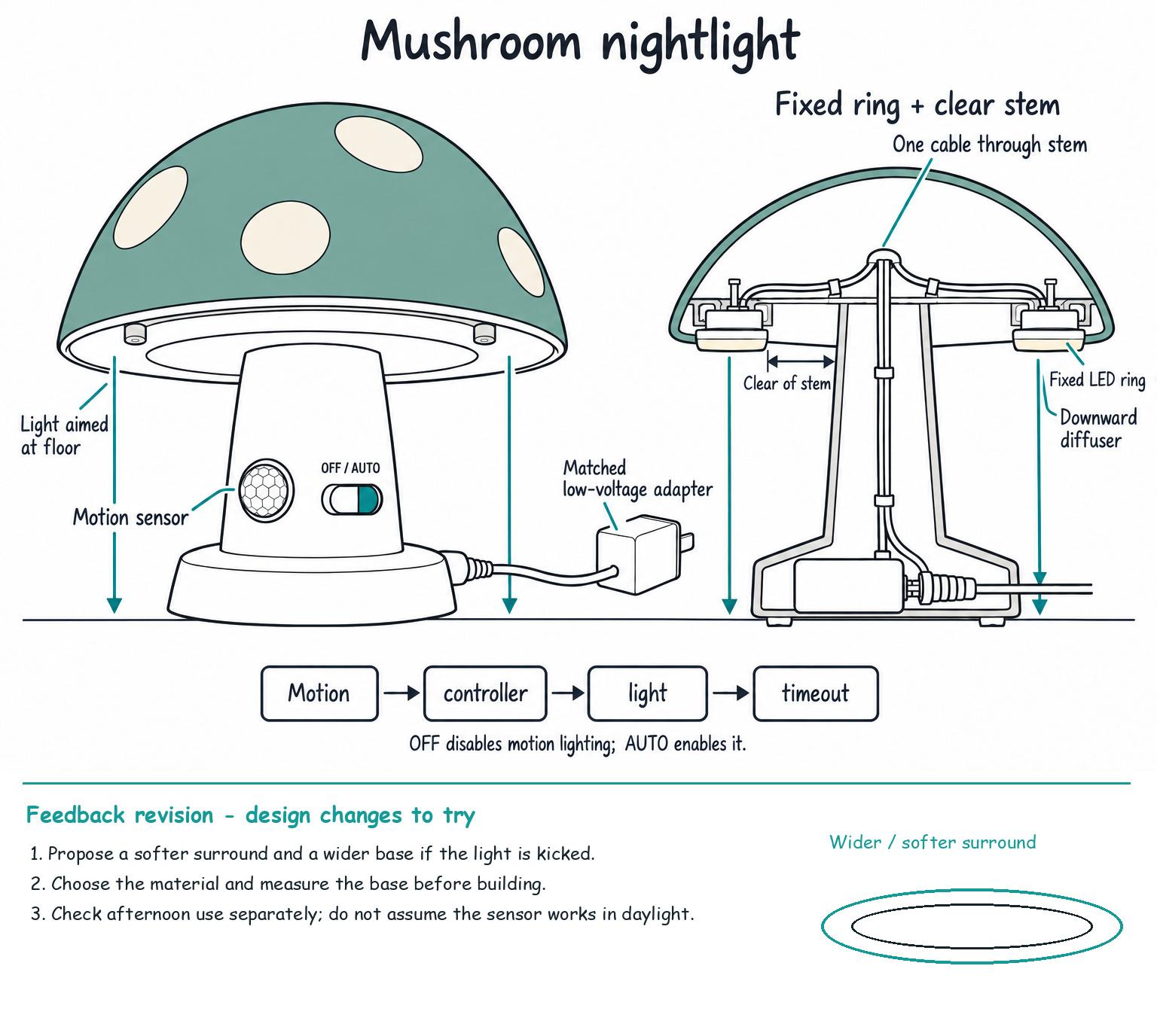
Who it could help: An older person getting out of bed
The problem
An older person getting out of bed needs to see the nearby floor.
Why it matters
The light should reach the floor and feel comfortable on the eyes.
The idea
A mushroom-shaped lamp that senses movement and shines down towards the floor.
How it works
- Set the switch to AUTO.
- Movement turns on the downward light.
- The light turns off after a pause.
What to find out
Does the light reach the floor without glare?
Check floor light, glare, timeout and stability beside a bed.
Feedback revision: changes to try
- Propose a softer surround and a wider base if the light is kicked.
- Choose the material and measure the base before building.
- Check afternoon use separately; do not assume the sensor works in daylight.
Earlier drawing is preserved
Compare the revision with the original before building.
Open the earlier illustration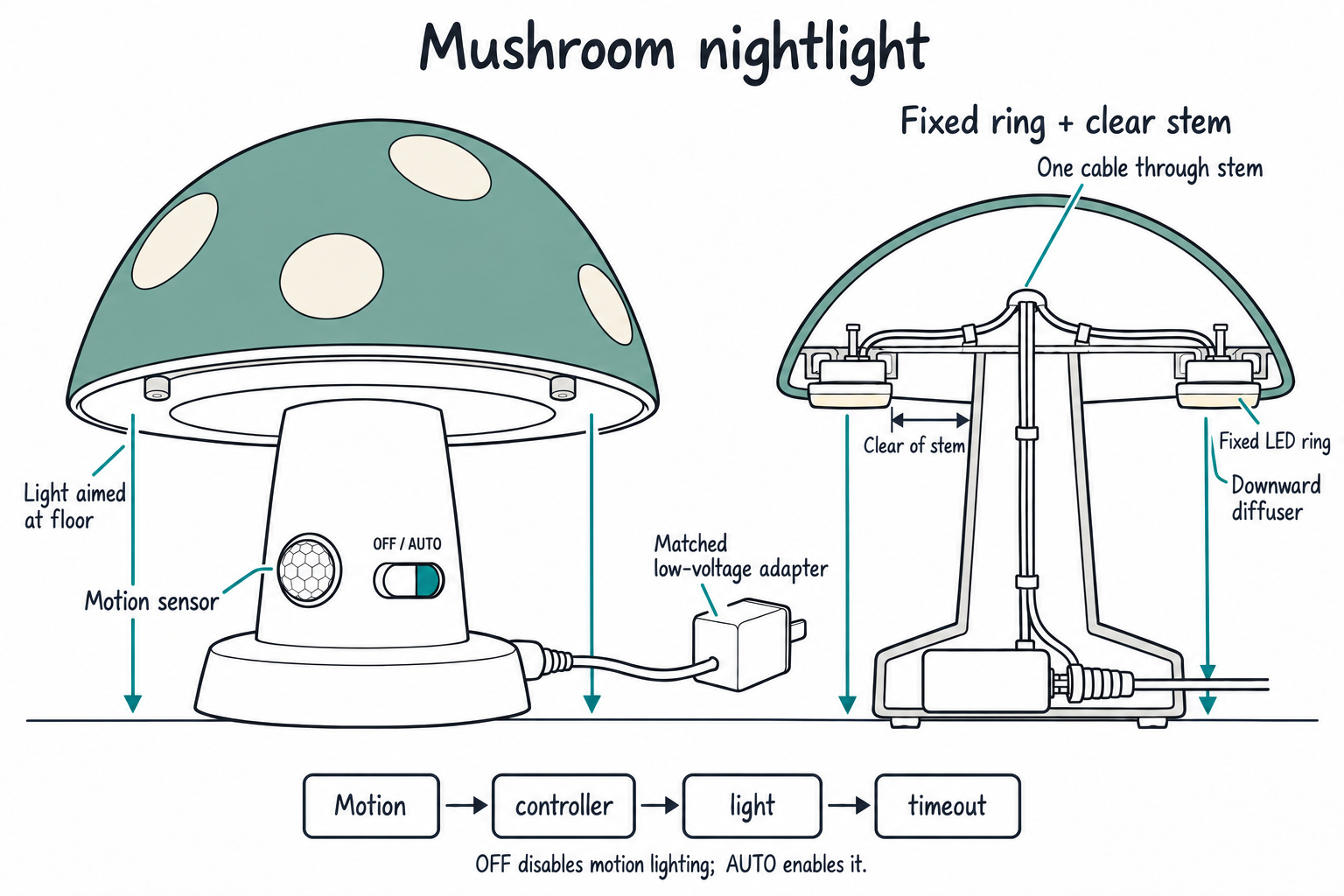
2D drawing and Tinkercad instructions
Read the current drawing, label one change, and keep the original. In your drawing workspace, use the illustration as a fixed reference and add editable marks over it. Save the draft, then submit the drawing separately from your written answers.
Build a 3D concept with your teacher
- Use a cylinder for the stem and a dome shape for the cap.
- Add a wider base and a separate soft-surround placeholder.
- Label the light and sensor spaces; use measured dimensions and supplied parts.
Use your assigned Tinkercad workspace. Verify the group, idea and units before opening an existing project. Duplicate it before changing it. Measure supplied parts and ask your teacher to check fit before printing. These instructions do not edit or connect to Tinkercad.
The prompts below contain the public design description only. They are not sent anywhere by FIT. A teacher or adult conducts the ChatGPT conversation and reviews any generated drawing or instructions. Keep pupil details and private submissions out of the prompt.
2D drawing prompt
Tinkercad instructions prompt
Idea 2: Robot sorting bin
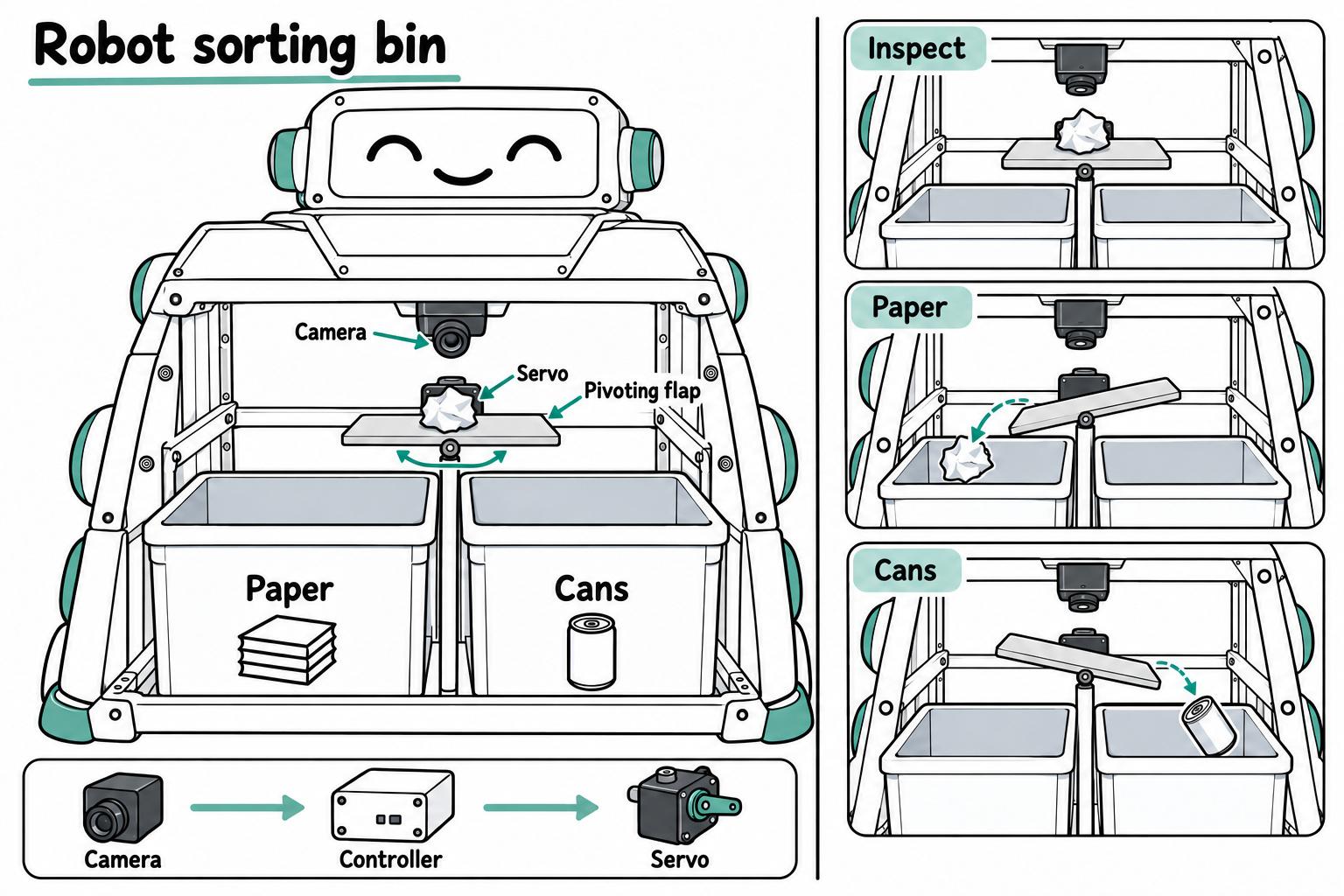
Who it could help: People sorting rubbish
The problem
People sometimes put rubbish into the wrong compartment.
Why it matters
The item needs a clear path into the chosen bin.
The idea
A robot bin that checks an item with a camera and uses a small flap to choose its route.
How it works
- The camera checks one item.
- The controller chooses a bin.
- The flap tilts to that bin.
What to find out
Which items can the camera recognise? What happens when it is unsure?
Try known and unknown items; check flap movement and jams.
Earlier drawing is preserved
Compare the revision with the original before building.
Open the earlier illustration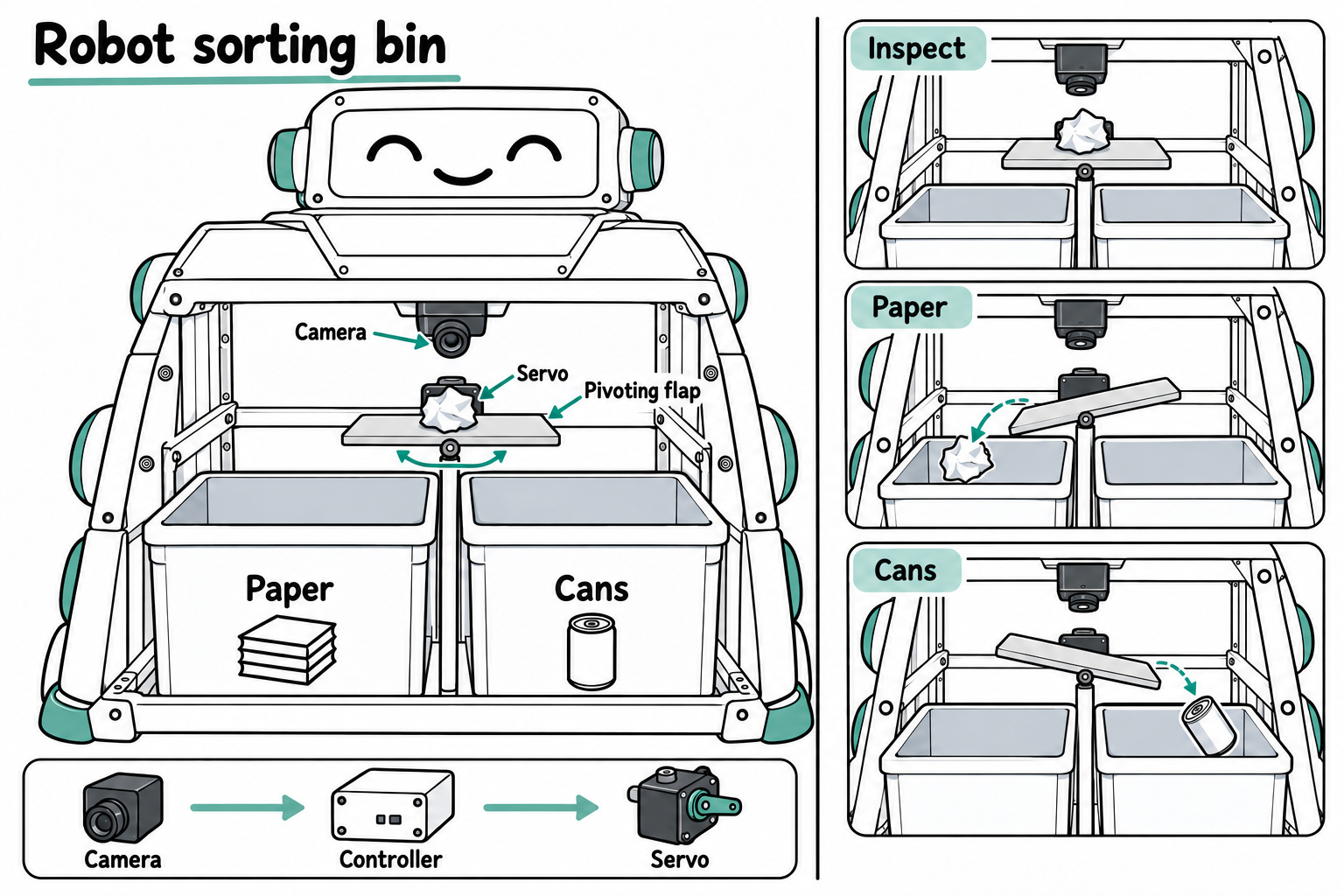
2D drawing and Tinkercad instructions
Read the current drawing, label one change, and keep the original. In your drawing workspace, use the illustration as a fixed reference and add editable marks over it. Save the draft, then submit the drawing separately from your written answers.
Build a 3D concept with your teacher
- Block out the main case with boxes and cylinders from the illustration.
- Keep each moving or electronic part separate and labelled.
- Measure the actual parts with the teacher before holes or printing.
Use your assigned Tinkercad workspace. Verify the group, idea and units before opening an existing project. Duplicate it before changing it. Measure supplied parts and ask your teacher to check fit before printing. These instructions do not edit or connect to Tinkercad.
The prompts below contain the public design description only. They are not sent anywhere by FIT. A teacher or adult conducts the ChatGPT conversation and reviews any generated drawing or instructions. Keep pupil details and private submissions out of the prompt.
2D drawing prompt
Tinkercad instructions prompt
Your three activities
Activity 1
Improve the problem
Name a person, one difficult step and the evidence we need.
- Read the problem statement and the suggested wording.
- Ask which step is difficult at the actual bedside: seeing the floor, reaching a control or avoiding glare.
- Choose one difficult step. Complete your own improved statement.
Check: Name who needs help, what is difficult and what you still need to test.
Activity 2
Make the idea work
Show a useful change and explain how the parts connect.
- Mark the sensor facing the person and keep it uncovered.
- Draw the light path towards the floor and the rear cable route.
- Label ON/OFF and the separate bought adapter.
Check: The drawing shows an input, movement or action, and a result. It distinguishes the printed structure from supplied equipment.
Activity 3
Test and explain
Compare fairly and explain what the result means.
- Use this comparison: The same light at the same position without the added cap lip; include an existing nightlight if available.
- Compare the two versions from a safe seated position. Try five movements in front of the stationary lamp and check OFF.
- Record what happened, or write the test plan if the equipment is not available. Explain one next change.
Check: Keep the lip only if the floor stays visible, glare improves for the observer and sensing is no worse. OFF must remain off during movement.
Start your shape model
- Choose one reviewed idea and sketch its main parts.
- In Tinkercad, use boxes or cylinders for the structure. Set the sizes from measurements and label supplied equipment separately.
- Show one useful change, check how parts would connect and save a screenshot of your model for your teacher.
Use your teacher’s assigned workspace. Do not enter class joining details or account information in your answers. Ask your teacher before printing, powering or physically testing equipment.
Optional presentation preparation (saved only on this browser)
Your group’s answers
Use group numbers only. Do not enter names, emails, logins or private class links. Answers stay in this browser, on this device. They are not sent to FIT or a teacher. Download or print a copy to share with your teacher. On a shared device, clear this group after keeping your copy.
Group 2 answers
Chosen idea: Not chosen
- The person and place
- Not answered
- The difficult step
- Not answered
- What we know or need to find out
- Not answered
- Our improved problem statement
- Not answered
- One change we choose and why
- Not answered
- Printed parts and parts we need to supply
- Not answered
- What we compare and keep the same
- Not answered
- Our result or planned measurement
- Not answered
- Our next change and reason
- Not answered
- Our main message for the presentation
- Not answered
Loading your saved answers.